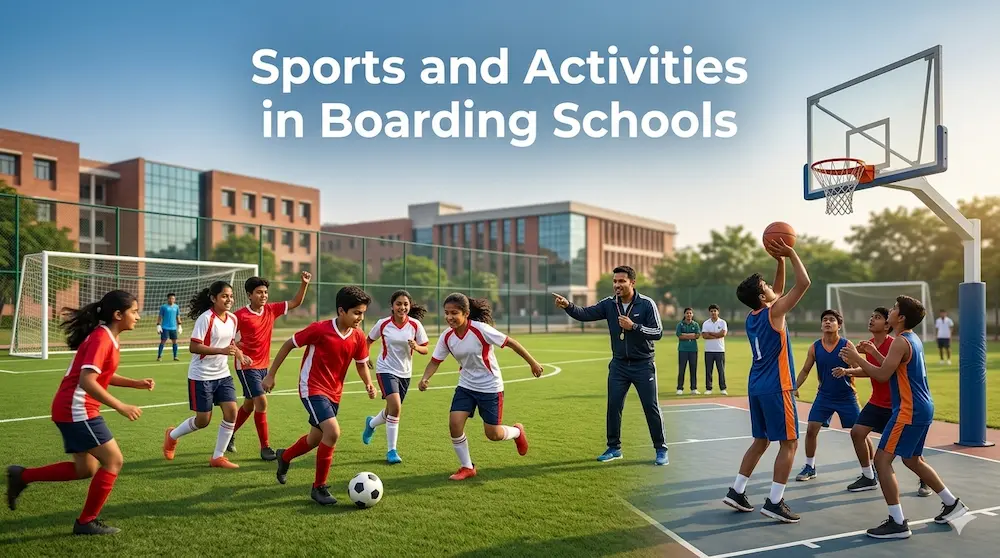
 Introduction
Most parents choose schools based on academics.
But here’s a reality that many realize too late.
The biggest transformation in a child does not happen in classrooms.
It happens on the playground, stage, and activity rooms.
Boarding schools have a unique advantage.
They provide structured time and space for activities every single day.
This guide explains what really matters when evaluating sports and activities in boarding schools.
(Also read: Life Inside a Boarding School Campus to understand full student life)
Why Activities Matter More Than Parents Think
Marks help in exams.
Activities build life skills.
What activities actually develop
- Confidence
- Leadership
- Communication
- Decision-making
- Stress handling
Real example:
Two students with similar marks. The one active in sports and debates performs better in interviews and real-world situations.
Types of Activities in Boarding Schools
Not all schools offer the same level of exposure.
1. Sports Activities
- Cricket, football, basketball
- Swimming, athletics
- Lawn tennis, badminton
2. Creative Activities
- Music (vocal/instrumental)
- Dance
- Theatre and drama
3. Intellectual Activities
- Debate
- Quiz competitions
- Public speaking
4. Skill-Based Activities
- Robotics
- Coding
- Art and design
Difference Between “Available” and “Active” Activities
This is where most parents get misled.
What schools say:
“We offer all major sports.”
What actually matters:
- Are students regularly participating?
- Are there trained coaches?
- Are competitions organized?
Example:
| School Type |
Reality |
| Average school |
Activities exist but are rarely practiced |
| Good school |
Regular practice but limited exposure |
| Top school |
Structured training + competitions |
Daily Activity Structure in Boarding Schools
Unlike day schools, boarding schools have fixed activity slots.
Typical structure:
- 1–2 hours daily sports time
- Weekend competitions
- Annual events and tournaments
This consistency is what creates real growth.
Role of Coaches and Mentors
Facilities don’t matter without proper guidance.
What parents should check:
- Qualified coaches
- Full-time vs part-time trainers
- Student-to-coach ratio
- Exposure to external competitions
Reality insight:
A smaller school with strong coaching can outperform a bigger school with weak guidance.
Competitive Exposure: The Real Differentiator
This is what separates average schools from top schools.
Check for:
- Inter-school competitions
- State/national level participation
- Sports achievements record
Why it matters:
- Builds confidence
- Opens career opportunities
- Improves discipline
How Activities Impact Career (Most Ignored Point)
Parents often think activities are “extra.”
But today, they directly impact future.
Examples:
- Sports → professional career or quota advantage
- Debate/public speaking → leadership roles
- Music/art → creative careers
- Team sports → management skills
Even for engineering or medical careers, personality matters in interviews.
Balance Between Academics and Activities
Parents worry about one thing:
“Will activities affect studies?”
In good schools, the opposite happens.
Why?
- Better time management
- Reduced stress
- Higher focus during study hours
Red flag:
If a school either ignores activities OR over-focuses on them without academic balance.
Common Mistakes Parents Make
Avoid these:
- Choosing school only for academics
- Ignoring activity infrastructure
- Not checking coach quality
- Assuming all schools provide equal exposure
- Not asking about competitions
How to Evaluate Activities During School Visit
Do this practically:
- Visit sports grounds during activity time
- Observe student participation
- Check equipment quality
- Ask about recent achievements
- Talk to students about activity culture
Key question to ask:
“How many students actively participate vs just attend?”
Signs of a Strong Activity Culture
- Students are engaged, not forced
- Coaches are visible and active
- Regular competitions happen
- Students talk positively about activities
How This Connects to Overall Campus Life
Activities are just one part of the full system.
To make a complete decision, also explore:
- Hostel life and daily routine
- Safety and supervision
- Emotional environment
(Read: Life Inside a Boarding School Campus)
FAQs
1. Are sports compulsory in boarding schools?
Most schools encourage participation but may not make it compulsory.
2. Do activities affect academic performance?
No. In fact, they improve focus and discipline.
3. Which sport is best for students?
Depends on interest, but team sports help in social development.
4. Are professional coaches available?
Good schools provide trained coaches for major sports.
5. Can activities help in future career?
Yes, especially in sports, leadership roles, and personality development.
6. How much time is given to activities daily?
Usually 1–2 hours in most boarding schools.


Comments (0)
Leave a Comment